Your field executive pays ₹1,800 for fuel and tolls on a client visit. The money comes from his own UPI account. He keeps the bill in his pocket, or tries to. Three weeks later, he files a claim. Finance asks where the bill went.
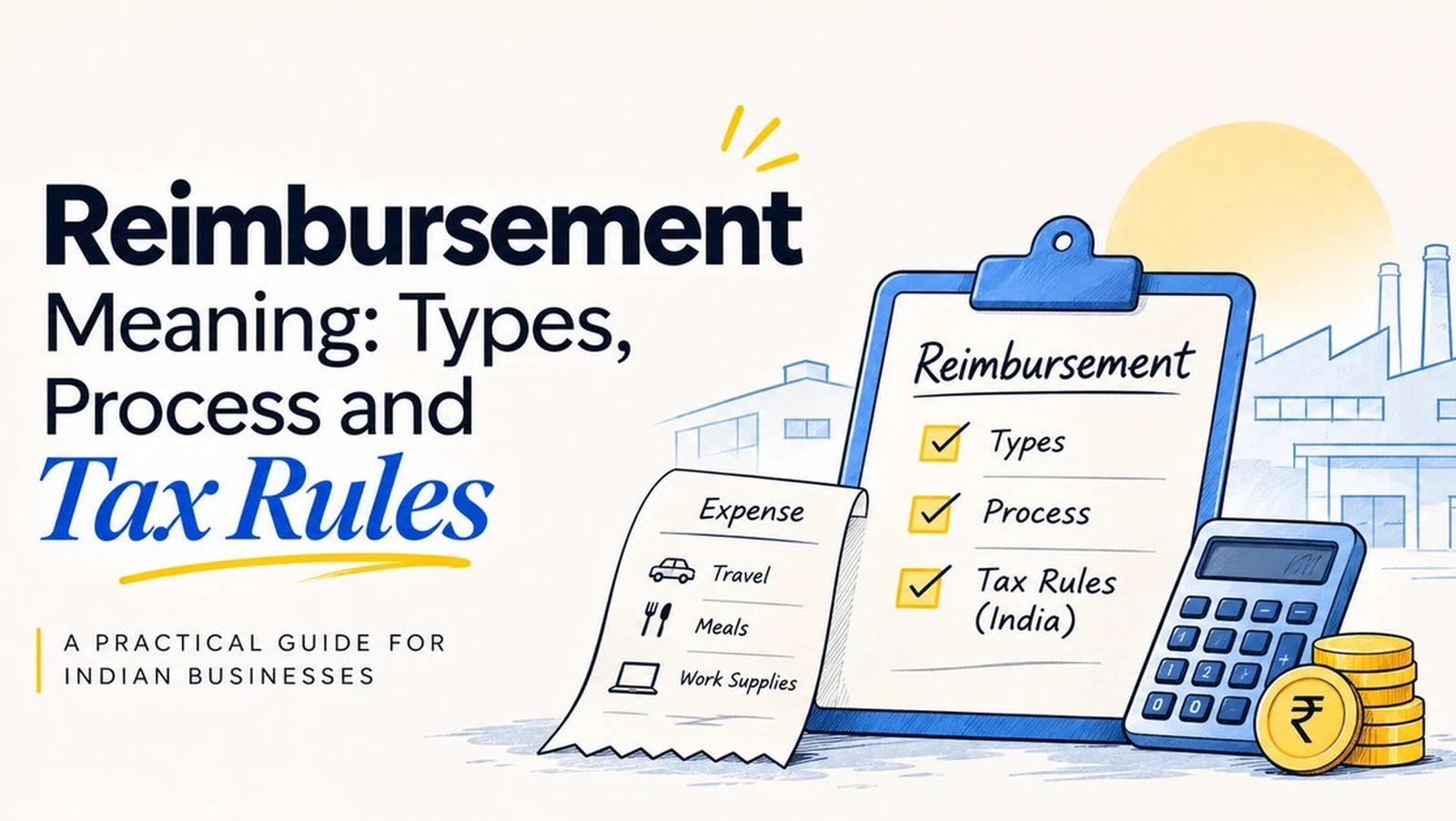
This is reimbursement in real life. The word sounds formal, but the idea is simple. This guide explains the reimbursement meaning, the common types and how a claim works. It also covers the tax rules. At the end, you'll see how some Indian companies now skip claims completely.
What is reimbursement?
Reimbursement means paying someone back for money they spent on your behalf. The person spends first. You return the exact amount later.
At work, the employee usually spends first. The company pays them back after checking the bill. This is called employee reimbursement.
Three things make a payment a reimbursement:
- The money was spent for someone else's work or need.
- The amount paid back matches the real cost.
- There is proof, like a bill or receipt.
Reimbursement meaning in Hindi and Tamil
In Hindi, reimbursement is called प्रतिपूर्ति (pratipurti). In Tamil, people describe it as செலவுத் தொகையைத் திருப்பி வழங்குதல். Both mean getting back money you already spent.
Reimbursement vs refund vs allowance
People mix these three words up all the time. Here is the difference.
| Term | What it means | Example |
|---|---|---|
| Reimbursement | You get back money you spent for someone else | Your company repays your client-visit fuel |
| Refund | You get back money for something returned or cancelled | An airline returns your ticket fare |
| Allowance | A fixed amount paid ahead, with or without bills | A set monthly conveyance amount |
Common types of reimbursement
The word shows up in a few places. Here are the ones you'll see most in India.
1. Employee business expenses
This is the most common type at work. Staff spend on company tasks and claim the money back. Typical items include:
- Train tickets, cabs and autos for work trips
- Fuel and tolls for field visits
- Food while travelling on duty
- Small purchases like spares, stationery or site material
- Phone and internet used for work
2. Medical and insurance reimbursement
You pay the hospital first. Your insurer pays you back after you file a claim. Cashless treatment works the other way, with the insurer paying the hospital directly.
3. Fee reimbursement
Some state governments pay back college fees for eligible students. Students in Telangana and Andhra Pradesh often search online for their fee reimbursement status.
4. Client or project reimbursement
Agencies and contractors often spend for a client and bill it back later. Courier, travel and hotel costs are common examples. This type has its own GST rules, covered below.
How a reimbursement claim works
Most companies follow some version of these six steps:
- The employee pays from their own money.
- They keep the bill or take a photo of it.
- They fill a reimbursement claim form.
- Their manager checks and approves it.
- Finance matches the bill to the claim.
- The company pays the amount, often with the next salary.
On paper, this looks tidy. In practice, each step can slow things down.
Where reimbursement claims go wrong
- Bills get lost, fade, or never get issued at the tea shop.
- Employees wait weeks to get their own money back.
- Managers approve claims without looking at the bill.
- Finance chases people for missing details at month-end.
- The same bill can get claimed twice by mistake.
Junior staff feel this the most. A ₹5,000 spend can strain someone on a small salary.
What a good reimbursement policy should cover
A clear reimbursement policy saves arguments later. Write down these six points.
| Policy point | What to decide |
|---|---|
| What is covered | List the costs you will pay back |
| Limits | Set a cap per category, like food per day |
| Proof | Say which bills or photos you accept |
| Deadline | Fix how many days staff get to file a claim |
| Approval | Name who approves each claim |
| Payment time | Say when the money will reach the employee |
Share the policy with every new joiner. Review it once a year.
Is reimbursement taxable in India?
The answer depends on what the money is for. Here is the general picture. Check your exact case with your CA.
Income tax for employees
The Income-tax Act, 2025 replaced the 1961 Act from 1 April 2026 (Mercans). Allowances tied to official duties stay exempt under the new law. These include travel on tour and conveyance for official work (CA Rajput).
Paying back real work costs with proper bills is generally treated as a company cost. A fixed monthly allowance with no link to real costs is usually taxed as salary.
GST on reimbursement
GST matters when one business recovers costs from another. Say an agency books a hotel for a client and bills it back. GST usually applies to that amount as part of the agency's service (TaxGuru).
The exception is the pure agent rule under Rule 33 of the CGST Rules, 2017 (Taxmann). To use it, the supplier must meet these conditions (Tally):
- The client has authorised them to pay on its behalf.
- The cost is shown as a separate line on the invoice.
- Only the actual amount spent is recovered.
- The supplier doesn't use the goods or services for itself.
Missing even one condition can make the whole amount taxable (TaxGuru).
How companies are moving to zero reimbursements
Here's a simpler idea. Let staff pay from company money at the counter itself. Then there is nothing to claim back.
Cash advances and petty cash try to do this today. The trouble is that cash is hard to track once it leaves the office. A company UPI wallet keeps the speed of UPI and adds a record of every rupee.
How this works with CUPI
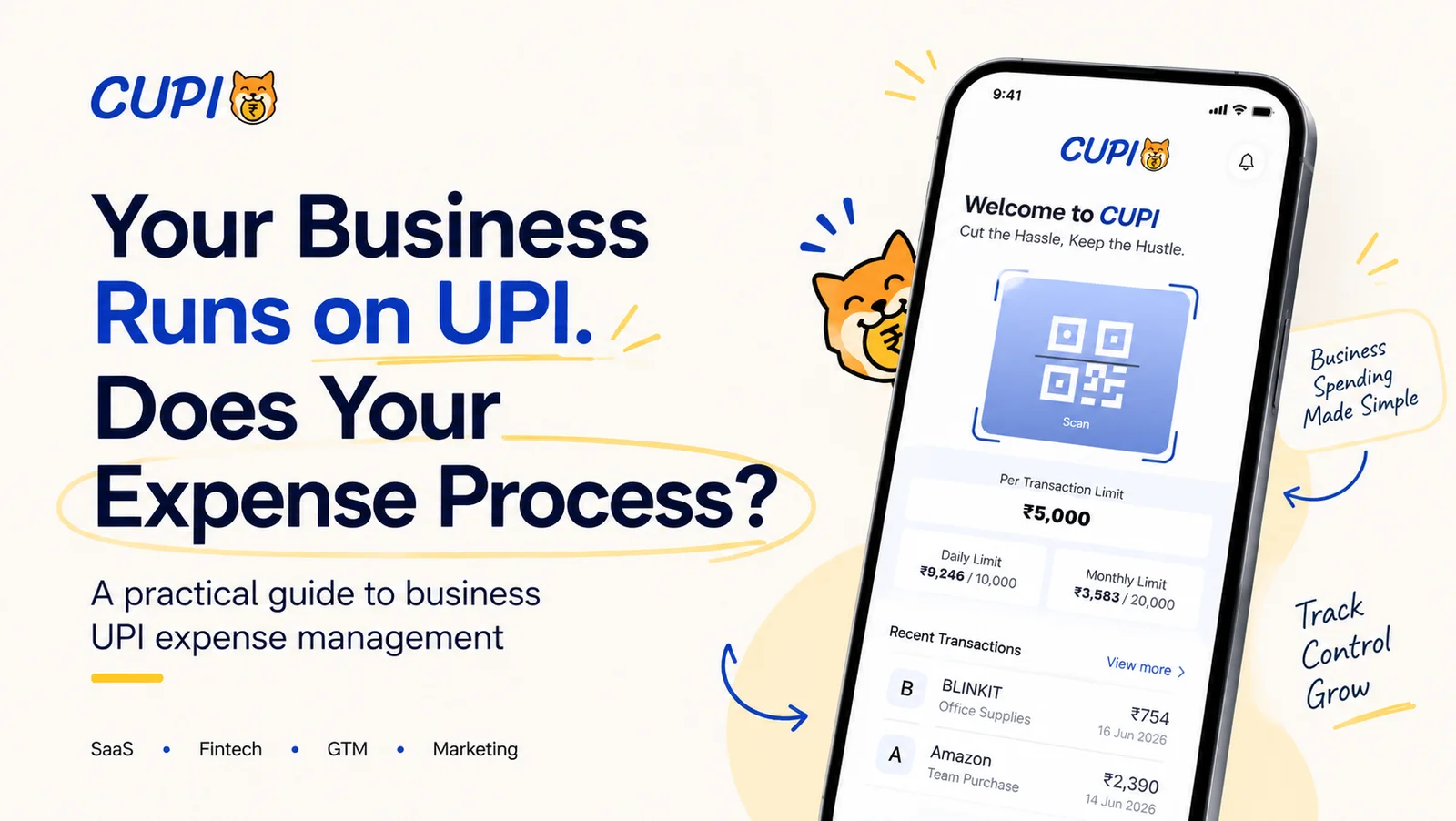
CUPI is India's first Business UPI expense payment platform. Here's the flow:
- Employees pay by UPI from one shared company wallet.
- Finance sets spend limits for each person.
- Every payment shows up live on the Admin Dashboard.
- Payments reconcile automatically, so month-end gets shorter.
Your team stops paying from personal accounts. That means zero reimbursement claims to file, check or pay. Coverage of CUPI notes that employees make business payments without using their personal money (CXO Digital Pulse).
Want to know how much cash slips through your business today? Try the CUPI Cash Leakage Calculator. You can also see examples by industry on CUPI's use cases page. For the full setup, read my guide to business UPI expense management.
The bottom line
Reimbursement means paying back money someone spent for you. At work, it keeps staff whole for company costs. A clear policy, proper bills and quick payment keep claims fair. Tax and GST rules depend on the type of cost, so check with your CA.
If claims take up too much of your finance team's month, look at the root cause. Most claims exist because staff pay from their own pockets. Give them a company wallet with limits, and the claims stop.
Related reading
- Petty cash management for Coimbatore's pump and foundry units
- Business UPI expense management: a complete guide
Sources
- Mercans: India changes in Income-tax Act and Rules effective 1 April 2026
- CA Rajput: Key highlights of India's new Income-tax Act, 2025
- TaxGuru: GST on reimbursement of expenses under Rule 33
- Taxmann: GST on reimbursements
- Tally: GST on reimbursement of expenses
- CXO Digital Pulse: CUPI targets thousands of businesses